
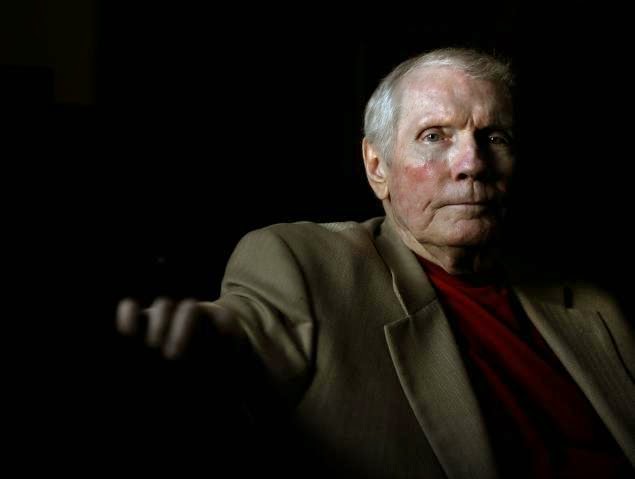
The news has just been released that Rev. Fred Phelps, founder and lifelong shepherd of the Westboro Baptist Church (in Topeka, Kansas) has died at the age of 84. I find it difficult, I confess, to summon the normal human compassion that usually accompanies news of another's death in this case, largely because Phelps dedicated his life to broadcasting his rejection of– not to mention enlisting others, including children, to stage carnival-like circuses around his rejection of– what most people would consider even the most minimally-decent exhibitions of human compassion. Fred Phelps was one of the most infamous, outrageous, dishonorable and genuinely despicable hatemongers of my generation. And, what is more, Fred Phelps' hate was as ferocious and vicious as it was blind. Through the prism of his delusional and evangelical abhorrence, the Westboro congregants en masse considered themselves justified in casting an unjustifiably wide net of Judgment. Caught in that net were many: ranging from bona fide innocents against whom no reasonable person could or ought cast aspersions, like Matthew Shepard, to a whole host of other "collateral-damage" victims of Phelps' quasi-political positions who found themselves the inadvertent and inauspicious targets of his his flock's detestation.
I say again: I find it very, very difficult to summon the normal human compassion that ought to accompany the news of Fred Phelps' passing.
Nevertheless, these are the moments when our inclination toward Schadenfreude, however deeply affirming and deeply satisfactory indulging that sentiment may feel, ought to be on principle squelched.
As a member of the LBGTQ community, I genuinely plead with my brothers and sisters in the trenches, and also with whatever allies mean to act on our behalf, to think carefully, to examine closely their own consciences, and to ask themselves whether or not anything is worth the cost of taking Phelps' low road. Because, in the end, that road belongs to Phelps and his kin: they built it, they traveled it, they own it, they collect the tolls on it, and it leads nowhere else other than they want it to go. One of the greatest among us (Audre Lorde) once said, and it is true in this case perhaps above any other, "the Masters tools will never dismantle the Masters house." Please do not picket Phelps' funeral. Please do not confuse a strategy that may in the moment appear to aid us with a strategy that has, and always will, defeat us.
Instead, I ask of the LGBTQ community that we "be quiet a minute." That advice is from Act 5, Scene 1 of Shakespeare's Hamlet, in which Hamlet is speaking with his dear friend Horatio and is considering the fate that befalls us all. Hamlet says (and I'm employing the Modern Translation here):
HAMLET: Just follow the logic: Alexander died, Alexander was buried, Alexander returned to dust, the dust is dirt, and dirt makes mud we use to stop up holes. So why can’t someone plug a beer barrel with the dirt that used to be Alexander? The great emperor Caesar, dead and turned to clay, might plug up a hole to keep the wind away. Oh, to think that the same body that once ruled the world could now patch up a wall! But quiet, be quiet a minute.
Like all of us, Fred Phelps was made of dust, and to dust he has returned. We will, of course, continue to have the disagreements we have had since time immemorial with regard to some conjectural "eternal life," to guesswork about the Final Judgment, to hypotheses about what (if anything) survives these mortal coils, none of which will ever be settled, definitively, in any way that is more resolutely known than what Hamlet articulates above. We will all, everyone of us, even and/or in spite of our beliefs to the contrary, return to dust.
So, the only really important question is: which holes do those of us (who are the remaining among us) try to plug with the dust of those who have passed? How do we make productive use of the loam we have now been given?
To wit, I think Hamlet's is good advice: "but quiet, be quiet a minute." (Or, even better yet, as it is in the original translation: "but soft, but soft awhile.") Let us be quiet, be soft, even and in spite of our otherwise inclinations at the moment. Or, rather, because of our otherwise inclinations at the moment.
Let us consider, instead of how we might get even, how me might get better.

 New APPS
Leave a comment