Must an infinitely continued life inevitably become boring? Bernard William famously answers yes; John Fischer no. Fischer’s case is perhaps even more easily made than he suggests — but its very ease opens up new issues.

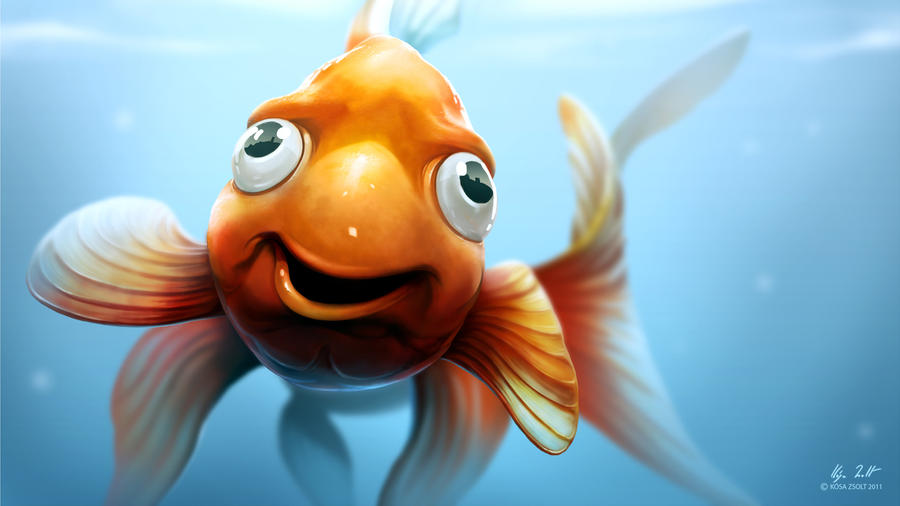
Consider Neil Gaiman’s story “The Goldfish Pool and Other Stories” (yes, that’s the name of one story):

He nodded and grinned. “Ornamental carp. Brought here all the way from China.”

We watched them swim around the little pool.”I wonder if they get bored.”

He shook his head. “My grandson, he’s an ichthyologist, you know what that is?”

“Studies fishes.”

“Uh-huh. He says they only got a memory that’s like thirty seconds long. So they swim around the pool, it’s always a surprise to them, going ‘I’ve never been here before.’ They meet another fish they known for a hundred years, they say, ‘Who are you, stranger?’”


The problem of immortal boredom solved: Just have a bad memory! Then even seemingly un-repeatable pleasures (meeting someone for the first time) become repeatable.


Now you might say, wait, when I was thinking about immortality I wasn’t thinking about forgetting everything and doing it again like a stupid goldfish.


To this I answer: Weren’t you?


If you were imagining that you were continuing life as a human, you were imagining, presumably, that you had a finite brain capacity. And there’s only so much memory you can fit into eighty billion neurons. So of course you’re going to forget things, at some point almost everything, and things sufficiently well forgotten could presumably be experienced as fresh again. This is always what is going on with us anyway, to some extent. And this forgetting needn’t involve any loss of personal identity, it seems: one’s personality and some core memories could always stay the same.


Immortality as an angel or transhuman super-intellect raises the same issues, as long as one’s memory is finite.


A new question arises perhaps more vividly now: Is repeating and forgetting the same types of experiences over and over again, infinitely, preferable to doing them once, or twenty times, or a googolplex times? The answer to that question isn’t, I think, entirely clear (and maybe even faces metaphysical problems concerning the identity of indiscernibles). My guess, though, is that if you stopped one of the goldfish and said, “Do you want to keep going?”, the fish would say, “Yes, this is totally cool, I wonder what’s around the corner? Oh, hi, glad to meet you!” Maybe that’s a consideration in favor.


Alternatively, you might imagine an infinite memory. But how would that work? What would that be like? Would one become overwhelmed like Funes the Memorious? Would there be a workable search algorithm? Would there be some tagging system to distinguish each memory from infinitely many qualitatively identical other memories? Or maybe you were imagining retaining your humanity but somehow existing non-temporally? I find that even harder to conceive. To evaluate such possibilities, we need a better sense of the cognitive architecture of the immortal mind.


Supposing goldfish-pool immortality would be desirable, would it be better to have, as it were, a large pool — a wide diversity of experiences before forgetting — or a small, more selective pool, perhaps one peak experience, repeated infinitely? Would it be better to have small, unremembered variations each time, or would detail-by-detail qualitative identity be just as good?


I’ve started to lose my grip on what might ground such judgments. However, it’s possible that technology will someday make this a matter of practical urgency. Suppose it turns out, someday, that people can “upload” into artificial environments in which our longevity vastly outruns our memorial capacity. What should be the size and shape of our pool?


[image source]


[Cross-posted at The Splintered Mind.]

Posted in ,

11 responses to “Goldfish-Pool Immortality”

  1. Aaron Lercher Avatar
    Aaron Lercher

    Ani DiFranco, “Little Plastic Castle” (recent performance):
    http://www.youtube.com/watch?v=BLffZu00ZMU

    Like

  2. Pavlos Avatar
    Pavlos

    Yes – but isn’t the problem that we get bored as it is, even with no immortality around and within a span of relatively short lives?

    Like

  3. Eric Schwitzgebel Avatar

    Pavlos: Your memory is just too good!
    Aaron: Very cool, thanks.

    Like

  4. Pavlos Avatar
    Pavlos

    I don’t think it has to do with memory. That assumes that somehow we only get bored by things we have already seen. But we get bored by new things as well. There are boring movies, boring people, boring meetings, boring landscapes, boring and uninteresting stuff all over the place. The literature is full of stuff about this. to quote a familiar dude: “Boredom is a vital problem for the moralist, since at least half the sins of mankind are caused by the fear of it.” B. Russell

    Like

  5. Eric Winsberg Avatar

    We get bored in our short lives, yes. But we don’t get bored, as far as I know, as a result of the length of our lives. We get bored because we get subjected to boring things. That’s neither the sort of boredom that would specifically be the result of immortality nor the sort we would expect to be alleviated by short memories. (although I think no movie would be uninteresting if my memory was too short to remember any past movies–surely the first movie we ever see is fascinating.)

    Like

  6. ben w Avatar
    ben w

    “If you were imagining that you were continuing life as a human, you were imagining, presumably, that you had a finite brain capacity.”
    Why make that presumption? I presumably wasn’t imagining a human body, that would sink into unusable decrepitude after—let’s be generous—a hundred and fifty years. Or why think that I was imagining anything about memory at all?

    Like

  7. Eric Schwitzgebel Avatar

    Right — maybe you weren’t, Ben. But you should have been, to give the scenario enough flesh to evaluate!

    Like

  8. Anon Avatar
    Anon

    I’m reminded of the old story about Zhuangzi remarking on how happy the fish are. His companion says, “How do you know, since you’re not a fish?” He answers, “How do you know I don’t, since you’re not me?”
    My students love the idea that immortality would be boring, they somehow find a way to bring it up even when we’re discussing something completely different (is it the Twilight movies?), but I find people’s quickness to accept the view a bit fishy (pun intended!).
    My principle objection is the assumption that novelty is essential to avoiding boredom. I’m inclined to think that most things that amuse and entertain necessarily involve some kind of repetition. I appreciate, for example, a movie, in part by identifying it and interpreting in its kind, based on its similarities to other instances of the genre, its place in a historical development, and so on. And there’s a great pleasure found in recognition and repetition for its own sake–the way children can demand the same story in exactly the same form again and again, or some people can watch their favorite movie over and over. Consider how any smartphone game is more or less the same game: push this button, get this reward.
    This isn’t to deny that variety plays a role, but that it doesn’t need to be–indeed never is–absolute. Nothing is new under the sun no matter how short your memory. Slight variations of which an infinite are possible should be enough to entertain the vampires among us.
    The insistence that we need the kind of variety that immortality can’t give strikes me as a motivated belief: a comforting belief for the all too mortal, and a flattering one, since it implies we’re too cool for the boring world, always ready for the new and different when, in reality, it’s more human to love and find comfort in sameness.

    Like

  9. Eric Winsberg Avatar
    Eric Winsberg

    maybe the finitude of memory doesn’t work by deleting the far past. maybe it deletes the details of memories, and aglomerates them into types. and maybe we would have enough memory to remember every type of experience, suitably coarse grained enough to make us bored by all of them.
    of course, few people want to kill themselves merely in virtue of boredom (faculty meetings excluded–there is fortunately usually nothing handy at a faculty meeting to carry out the task).

    Like

  10. Eric Schwitzgebel Avatar

    Anon: I agree, it is interesting, and fishy — probably a motivated belief — how attracted people seem to be to the boredom hypothesis. I agree that variations on a theme can be interesting — probably a sweet-spot for interest in many cases, actually. Music is another good case. I do still suspect, though, that some of the goldfish-pool forgetting inevitable in a finite mind is helpful, or maybe even practically necessary: However much I love Monty Python’s dead parrot skit, it might get tiresome after 10^100 remembered repetitions.

    Like

  11. Eric Schwitzgebel Avatar

    Eric W: Yes, that sounds reasonable! What you’re doing, which seems like the proper way for this literature to go, is to think about what the possible cognitive architectures of the immortal mind would be, and what the desirability of immortality would be under the various possible architectures.

    Like

Leave a comment