
by Eric Schwitzgebel
As Carolyn Dicey Jennings and I have documented, academic philosophy in the United States is highly gender skewed, with gender ratios more characteristic of engineering and the physical sciences than of the humanities and social sciences. However, unlike engineering and the physical sciences, philosophy appears to have stalled out in its progress toward gender parity.
Some of the best data on gender in U.S. academia are from the National Science Foundation’s Survey of Earned Doctorates (SED). In an earlier post, I analyzed the philosophy data since 1973, creating this graph:
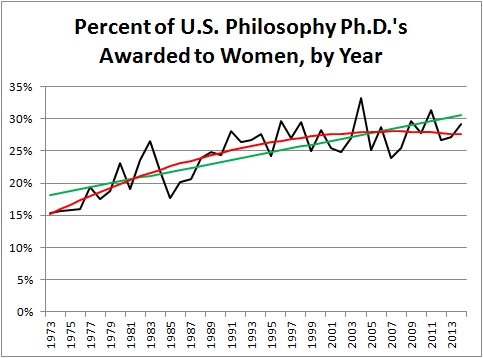
The quadratic fit (green) is statistically much better than the linear fit (red; AICc .996 vs .004), meaning that it is highly unlikely that the apparent flattening is chance variation from a linear trend.
Since the 1990s, the gender ratio of U.S. PhDs in philosophy has hovered steadily around 25-30%.
The SED site contains data on gender by broad field, going back to 1979. It is interesting to juxtapose these data with the philosophy data. (The philosophy data are noisier, as you’d expect, due to smaller numbers relative to the SED’s broad fields.)

The overall trend is clear: Although philosophy’s percentages are currently similar to the percentages in engineering and physical sciences, the trend in philosophy has flattened out in the 21st century, while engineering and the physical sciences continue to make progress toward gender parity. All the broad areas show roughly linear upward trends, except for the humanities which appears to have flattened at approximately parity.
These data speak against two reactions that I have sometimes heard to Carolyn’s and my work on gender disparity in philosophy. One reaction is “well, that just shows that philosophy is sociologically more like engineering and the physical sciences than we might have previously thought”. Another is “although philosophy has recently stalled in its progress toward gender parity, that is true in lots of other disciplines as well”. Neither claim appears to be true.
[I am leaving for Hong Kong later today, so comment approval might be delayed, but please feel free to post your thoughts and I’ll approve them and respond when I can!]
 New APPS
5 responses to “The Gender Situation Is Different in Philosophy”
I’m curious about the AIC stats (and root mean square error) for linear vs. quadratic regressions for each of the broad fields. Specifically, I’m not confident based on visual inspection alone that physical science hasn’t leveled off.
LikeLike
Right, I only did the AIC stats for philosophy, comparing the linear and quadratic fits. It’s possible nonlinear fits are also good matches for the other areas too.
To do a rigorous statistical comparison between the areas, I might want to convert from raw percentages to odds ratios, and I’d have to think about what to do with percentages over 50%, assuming that 50% is the parity target. In any case, with the large numbers involved, it would be surprising if the visually evident differences, in both slope and percentage, weren’t statistically significant by any reasonable measure.
If the physical sciences have slowed, it still seems the case both that the increase is greater than in philosophy and the slope steeper over the period from the 1990s to the present. Maybe if we just look at 2000-2014 there is no difference in slope between philosophy and the physical sciences. That could be interesting as a post-hoc test.
LikeLike
Of course, this couldn’t have anything at all to do with philosophy’s emphasis on adversarial methodology that is inherently culturally militaristic, valorizing warrior masculinity.
LikeLike
Thanks for this work, Carolyn & Eric.
It’s hard not to wonder what explains the difference between STEM and philosophy, and how we might move past our current state of stagnation.
I’m sure there are many explanations for the stagnation in philosophy, but one may be that philosophy is a neglected field. Certainly it doesn’t get the grants or attention of any of the STEM fields, so the fact of its embarrassing gender proportions has not been subjected to the scrutiny of the STEM fields. There is no NSF ADVANCE program for philosophy, etc.
I would hope that many recent developments in philosophy would help make a difference — the gendered conference campaign, the increased attention to sexual harassment, the very existence of the feminist philosophers blog, the renewed attention to how philosophers might make their discourse more civil, etc. But is it far too little far too late?
Sometimes I despair..
LikeLike
Thanks very much for this. There appears to be a typo: “Red” and “green” should be reversed in the text describing the first plot.
LikeLike