• Due to the suggestion of Lionel McPherson in comments at this post, I am disaggregating the non-white category of this previous post into three lists: "Hispanic," "Asian or Pacific Islander," and "Black" graduates of PhD programs in philosophy, per graduating institution. Importantly, the data only cover permanent residents and citizens of the United States (thanks to Brian Weatherson for pointing this out). Because of that fact I use data from the United States census as a point of comparison above each list.

    Note that the data on graduates was provided by the National Center for Science Engineering Statistics thanks to Eric Schwitzgebel's efforts (see here and here). Specifically, the NCSES supplied the number of racial and ethnic minority graduates from doctoral philosophy programs in the United States between the years 1973 and 2014 (but not broken down by year).

    Below, I list the programs in the United States with a higher than average (mean) percentage of graduates from each of these categories, where the mean is taken for 96 programs in the United States (I omitted institutions from the NCSES data that no longer offer doctoral degrees in philosophy)…

    (more…)

  • Most of us know about efforts to sort philosophy programs according to placement rate or prestige, but what of the percentage of PhD graduates from each program who are women or other underrepresented minorities? Thanks to Eric Schwitzgebel's efforts in contacting the National Center for Science Engineering Statistics (see here and here), we have access to some numbers on this issue. Specifically, the NCSES supplied the number of women and minority graduates from doctoral philosophy programs in the United States between the years 1973 and 2014 (but not broken down by year). Below, I provide the top programs in the United States from this list of 96 programs in terms of % of women graduates in this period, as well as the top programs in terms of % of non-white graduates, where for "non-white" I am aggregating the NCSES categories of "Hispanic," "Asian," "Asian or Pacific Islander," "Black" and "two or more races." (I omitted institutions from the NCSES data that no longer offer doctoral degrees in philosophy.) One striking feature of these lists is how many of the programs show up on Brian Leiter's list of PhD programs "whose existence is not easy to explain."  A provocative rhetorical question follows: Should we be closing PhD programs that better serve women and minorities in philosophy? I welcome discussion below.

    (more…)

  • By Catarina Dutilh Novaes

    It is well known that philosophers like to argue, and one of the things they like to argue about is arguing itself. Argumentation is frequently (and rightly, to my mind) taken to be a core feature of philosophical practice, and thus how to argue becomes a central topic for philosophical methodology. But many have claimed that the centrality of argumentation within philosophy is a weakness rather than a strength, deploring the excessively adversarial nature of argumentation in philosophy. Critics point out that philosophers are trained to find objections, counterexamples, rebuttals etc. to what their philosophical interlocutors say, who are tellingly described as one’s opponents. On this conception, argumentation is a duel between two opponents, and only one of them can win; blood will often ensue. Much of the criticism has been motivated by feminist concerns: aggressive, adversarial styles of argumentation are oppressive towards women and other disadvantaged groups, emphasizing competition (which is often presented to be an essentially ‘male’ feature) at the expense of cooperative, presumably more productive endeavors. Some of the authors having defended ideas along these lines are Janice Moulton and Andrea Nye (see here for a survey article by C. Hundleby).

    A few years ago I became interested in how the presumed adversarial nature of philosophical argumentation affected not only the practice but also the outcome of philosophical investigation. It seemed to me that, while some of the feminist criticism definitely struck a cord if not with the theory at least with the practice of philosophy in some (well, many) quarters, the general critical stance that is characteristic of philosophical interactions was still an essential and epistemically valuable feature of the philosophical method. (Btw, it may be worth noting that this is not unique to philosophy; mathematics seems to proceed by ‘proofs and refutations’ (Lakatos), and in many if not all of the empirical and social sciences, objections and criticism are the bread-and-butter of the theorist.)

    (more…)

  • So we all know that there’s a difference between “sex,” taken as a biological characteristic, and “gender,” as a social one. Maybe the heuristic is overdrawn (put down the updated theory; that’s not where this is going), but it works pretty well as a heuristic. It also has just led to a (maybe not so surprising) study result (paywalled; for a quick video summary, see here, though you may get served an ad): among young people with premature Acute Coronary Syndrome (ACS; it’s an umbrella term for anything involving a sudden reduction or block of blood flow to the heart, such as a heart attack), being gendered female – of self-identifying with traits that are traditionally associated with women – increases the risk of recurrence over the next 12 months. Being a woman (i.e., biological sex) does not affect future risk. As the authors say:

    “Gender-related characteristics like personality traits and social roles (psychosocial sex) may be as important as biological sex in predicting adverse cardiovascular outcomes in young patients with acute coronary syndromes. Both women and men with personality traits and social roles traditionally attributed to women are at increased risk of subsequent adverse events.”

    I make no assessment of how robust this result is (I noticed that the cohort was fairly small).  I will note that the study did not take race into account, although everything we know about intersectionality says that young women of color are likely to have even worse outcomes.

  • by Eric Schwitzgebel

    The Survey of Earned Doctorates is a questionnaire distributed by the U.S. National Science Foundation to doctorate recipients at all accredited U.S. universities, which draws response rates over 90% in most years. The survey includes data on gender and ethnicity/race. Data for 2009-2014 are readily available online here. At my request, the NSF sent me gender and ethnicity/race data for philosophy going back to 1973.

    With the NSF’s permission, here are the raw data. Philosophy response rates averaged 92% per year, and were over 85% in all years but two.

    (Note: “Ethics” started being collected as a separate doctoral subfield in 2012. For gender analysis, I have merged the 83 recipients in that category with the 1442 “philosophy” doctoral recipients during the same period. Given the small numbers, much of the race/ethnicity data were suppressed, so for race/ethnicity analysis I have excluded the “ethics” recipients. The numbers are not sufficiently different from “philosophy” to make a material analytic difference in a pool of over a thousand (54/83 [65%] male; among U.S. citizens and permanent residents, 52/68 [76%] non-Hispanic White).)

    Data on Women:


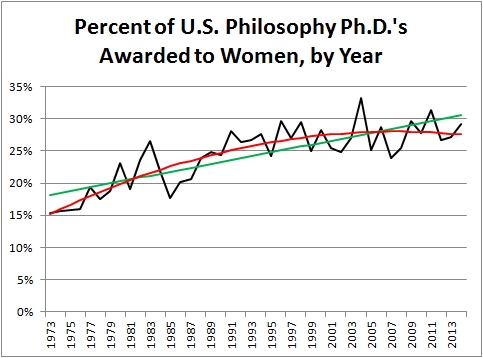
    Almost all respondents reported gender as male or female, with only 25/14495 respondents (0.2%) declining to self-classify gender. The total number of respondents increased from an average of 354/year in available data from the 1970s to an average of 484/year for available data in the 2010s. The chart below shows the percentage of women by year, along with both a linear regression line (green) and the best fitting quadratic curve (red).

    (more…)

  • By Gordon Hull

    We’ve known for a while, thanks to work by scholars such as Stephen Menn, that Descartes was in many ways a deeply religious and conservative thinker, one who took great care to try to align his work with Church doctrine, and who engaged scholastic thought with a good deal more precision than his dismissive comments suggest. One need only compare his assertions about the epistemic veracity of “ideas” as opposed to linguistic expression, to see the point. Indeed, as Tad Schmalz documents in detail, Descartes and his followers’ problem – and why he ended up on the banned books list – wasn’t any of the things that you might initially think, like the cogito, but the inability of his followers to explain the Eucharist (this shows up as early as Arnauld’s replies; in a way, the failure was inevitable, since the official explanatory apparatus of the Eucharist, as a product of the 1300s, presupposed Aristotelian physics, which Descartes rejected). Foucault’s lectures On the Government of the Living deepen that picture and apply it to the world we live in today.

    In his Descartes and Augustine, Menn makes the case that Descartes is fundamentally an Augustinian thinker in many ways. The cogito (Descartes never says “cogito ergo sum” in his own voice, by the way, so really we are talking about the res cogitans) appears to be lifted straight from Augustine. Via Menn, then, here is the Augustine. I apologize for the length, but if you’re not familiar with it, the passage is worth it (for the TLDNR crowd, I’ve boldfaced the parts that get the point across most succinctly:

    (more…)

  • by Gordon Hull

    An important trademark and First Amendment case was decided in the Federal Circuit yesterday. In it, the Court ruled in favor of Simon Tam, who named his band “The Slants.” When he attempted to register the band name as a trademark, the Patent and Trademark Office (PTO) rejected the mark as “disparaging,” arguing that the First Amendment does not allow government to disfavor speech that it disapproves of the message it contains. Per the Court:

    “The government cannot refuse to register disparaging marks because it disapproves of the expressive messages conveyed by the marks. It cannot refuse to register marks because it concludes that such marks will be disparaging to others. The government regulation at issue amounts to viewpoint discrimination, and under the strict scrutiny review appropriate for government regulation of message or viewpoint, we conclude that the disparagement proscription of § 2(a) is unconstitutional. Because the government has offered no legitimate interests justifying § 2(a), we conclude that it would also be unconstitutional under the intermediate scrutiny traditionally applied to regulation of the commercial aspects of speech.”

    The Court thus rules that the PTO needs to allow the mark to be registered (for a quick blogpost, see here). A lot of people think this case has ramifications for whether the Washington "Redskins" should be allowed to keep their trademark registrations (they were canceled by the 4th Circuit; the Washington Post has a long list of rejected marks here). The conflict between the circuits raises the odds of Supreme Court review.  I wrote about the Redskins case when it came out, and a lot of what I said there applies here. In that post, I expressed some support for the PTO, because I wonder if the case shouldn’t be framed as viewpoint discrimination so much as whether one has a constitutionally protected right to a government subsidy for speech that it does not endorse.  But it's not a comfortable road to travel, as I based my argument on abortion cases, Rust v Sullivan in particular, that I wish were decided the other way.

    (more…)

  • by Gordon Hull

    In their critique of Foucault that accompanies their translation of his writings on Iran, Janet Afary and Kevin Anderson accuse Foucault of a certain Orientalism: “indeed, similar to a passionate Romantic, Foucault may have exoticized and admired the East from afar, while remaining a Westerner in his own life” (17). Evidence for this charge is not too hard to find; the most striking may be his assertion in History of Sexuality I that non-Western societies practiced an ars erotica but not a scientia sexualis. In the context of Iran, Foucault’s self-qualification that he’s read “three books” on Shi’ism doesn’t inspire confidence in the person who claims that genealogy requires a “relentless erudition.”

    But then there’s this: “in an unusual turn, however, Foucault’s ‘orient’ seems to include the Greco-Roman world as well as the modern Eastern one, since the contrast he draws is primarily between tradition and modernity rather than East and West as such” (Afary and Anderson,18).

    (more…)

  • For NewAPPSThis evening I had an opportunity to get together with the other women in my philosophy department at UC Davis, and it caused me to reflect on how far we have come – when I joined the department in 2006, I was the only woman.  Elaine Landry (front center) joined in 2008, followed by Marina Oshana (back right) in 2009.  We stayed that while for awhile, until a recent spate of hires gave us Tina Rulli (front left) in 2014 and Zoe Drayson (back center) and Alyssa Ney (front right) starting just this fall.  We are now 6 full-time women faculty out of 15!  So, I just wanted to take this moment to celebrate, hoping that others have similar stories to tell and that they will share them here.  Please do!

  • By Gordon Hull

    Since we’re in the interregnum between “sign up for health insurance” time and “eat yourself into a stupor” time, it’s appropriate to notice something about pastoral power and our healthcare system. First, we’ll go back in time. Foucault proposes that pastoral power under medieval Christianity:

    “Gave rise to an art of conducting, directing, leading, guiding, taking in hand, and manipulating men, an art of monitoring them and urging them on step by step, an art with the function of taking charge of men collectively and individually throughout their life and every moment of their existence.” (Security, Territory, Population (=STP), 165)

    He then urges that this is not the same as political power, the power used to educate children, nor is it persuasion (“in short, the pastorate does not coincide with politics, pedagogy, or rhetoric” (164)). The pastorate does not disappear with the rise of modern power forms, as he emphasizes in a couple of places (STP 148, 150). Indeed, he makes a much stronger claim: “I think this is where we should look for the origin, the point of formation, of crystallization, the embryonic point of the governmentality whose entry into politics … marks the threshold of the modern state” (165).

    (more…)