(Cross-posted at M-Phi)

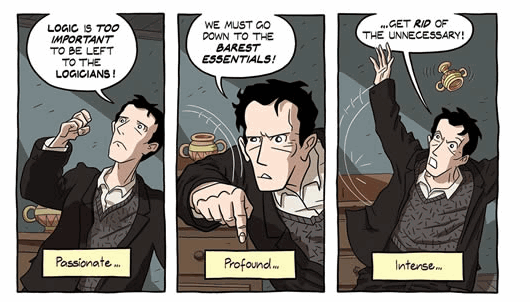
( From the graphic novel Logicomix, taken from this blog post by Richard Zach.)

“He doesn’t want to prove this or that, but to find out how things really are.” This is how Russell describes Wittgenstein in a letter to Lady Ottoline Morrell (as reported in M. Potter’s wonderful book Wittgenstein's Notes on Logic, p. 50 – see my critical note on the book). This may well be the most accurate characterization of Wittgenstein’s approach to philosophy in general, in fact a fitting description of the different phases Wittgenstein went through. Indeed, if there is a common denominator to the first, second, intermediate etc. Wittgensteins, it is the fundamental nature of the questions he asked: different answers, but similar questions throughout. So instead of proving ‘this or that’, for example, he asks what a proof is in the first place.

(My own take in my work on the philosophy of logic and mathematics is broadly Wittgensteinian (the later Wittgenstein, that is) in that I focus specifically on the human practices that fall under the heading of logic and mathematics — in particular the cognitive aspects of these activities.)

I’ve been toying around with the idea of putting together a master’s course on Wittgenstein, and now I’m thinking of something along the lines of ‘Wittgenstein on the nature of logic and mathematics'. (Btw, I highly recommend Juliet Floyd's chapter on Wittgenstein in the Oxford Handbook of Philosophy of Mathematics and Logic.) Half of it would be on the Tractatus, and the other half on later writings, in particular the Remarks on the Foundations of Mathematics.

The goal of the course would not be exclusively historical/exegetical; in fact, I am convinced that Wittgenstein asked all the right questions about logic and mathematics. So a systematic reflection on these topics does well to begin with the questions he asked and to engage with his answers, even if ultimately to reject the answers. The fact that he often focuses on very simple examples have led many to think that he did not really understand higher-level mathematics. But this is simply because for Wittgenstein, to understand the complex cases, we first need to understand the basics of the simple cases — which turn out to be everything but simple or straightforward.

And now, to my delight, it looks like I’ll be teaching such a course in the next academic year; can’t wait to go down to the barest essentials with Wittgenstein! (I anticipate an overflow of Wittgenstein-related blog posts in due course.)

Posted in , ,

6 responses to “Wittgenstein on the barest essentials”

  1. Jon Cogburn Avatar
    Jon Cogburn

    Oh man I wish I could take that course!
    I think what makes philosophers truly great is not so much their specific views, but rather that they ask the right questions. I’d love to read Wittgenstein closely with that in mind.

    Like

  2. CJ Avatar
    CJ

    Just out of curiosity, do we know how much mathematics LW did understand? He must have known some calculus for his work as an engineer, I suppose. Could he chat about geometry with Frege? Did he sit in on lectures by Ramsey or Turing?

    Like

  3. Nicolas McGinnis Avatar
    Nicolas McGinnis

    He knew more mathematics than is usually supposed, enough to cast serious doubt on those who claim that his remarks on the incompleteness proofs indicates he didn’t understand them.
    Mathieu Marion, for instance, uncovers evidence that Wittgenstein was quite capable of providing ‘constructive’ proofs, e.g., of Euler’s proof of the infinity of primes (see Marion, M. “Wittgenstein and Brouwer,” in Synthese 137, p. 103-127, 2003).
    I’ve argued that Wittgenstein’s return to philosophy was in large part motivated by exposure to intuitionism and constructive mathematics, which eventually up-ended his views on meaning and language generally.

    Like

  4. H. Teichman Avatar
    H. Teichman

    (My son Matt recently recommended your blog, which I was unaware of.)
    The most insightful writings on the RFM that I know of are Cora Diamond’s early paper “The face of necessity” (in her collection The Realistic Spirit) and Jacques Bouveresse’s two books Le Pays des possibles and La Force de la regle (none of Bouveresse’s best books have been translated, alas).
    Kripke has done some very original work on our concept of natural number, given publicly in his 1992 Whitehead Lectures, that is (perhaps unwittingly, as he in part argues there against one of Wittgenstein’s theses) in a late Wittgensteinian spirit. Hopefully these lectures will be published very soon.
    Best of luck with the course. The RFM deserves to be read more widely.

    Like

  5. Catarina Dutilh Novaes Avatar

    Thanks! How nice, inter-generational philosophical dialogues 🙂 My father was also very interested in philosophy, as a historian of medicine. But he died when I was still an undergraduate, so we never got to have deeper discussions. (He thought it was a pity though that I focused on logic rather than on political philosophy…)
    And I couldn’t agree more, RFM is a great text; it raises all the right questions about logic and mathematics. (As for the answers…)

    Like

  6. H. Teichman Avatar
    H. Teichman

    Please let me also recommend Elizabeth Anscombe’s paper “The question of linguistic idealism” in the third volume of her Collected Philosophical Papers (though it doesn’t talk much about math, it is very deep on how ‘essence is expressed by grammar’). For some reason Bernard Williams’s somewhat later and comparatively trivial paper on the same topic seems much better known now (it’s in his Moral Luck).

    Like

Leave a reply to Nicolas McGinnis Cancel reply