I don’t often attempt to fly when walking across campus, but yesterday I gave it a try. I was going to the science library to retrieve some books on dreaming. About halfway there, in the wide-open mostly-empty quad, I spread my arms, looked at the sky, and added a leap to one of my steps.

My thinking was this: I was almost certainly awake — but only almost certainly! As I’ve argued, I think it’s hard to justify much more than 99.9% confidence that one is awake, once one considers the dubitability of all the empirical theories and philosophical arguments against dream doubt. And when one’s confidence is imperfect, it will sometimes be reasonable to act on the off-chance that one is mistaken — whenever the benefits of acting on that off-chance are sufficiently high and the costs sufficiently low.


I imagined that if I was dreaming, it would be totally awesome to fly around, instead of trudging along. On the other hand, if I was not dreaming, it seemed no big deal to leap, and in fact kind of fun — maybe not entirely in keeping with the sober persona I (feebly) attempt to maintain as a professor, but heck, it’s winter break and no one’s around. So I figured, why not give it a whirl?

I’ll model this thinking with a decision matrix, since we all love decision matrices, don’t we? Call dream-flying a gain of 100, waking leap-and-fail a loss of 0.1, dreaming leap-and-fail a loss of only 0.01 (since no one will really see me), and continuing to walk in the dream a loss of 1 (since why bother with the trip if it’s just a dream?). All this is relative to a default of zero for walking, awake, to the library. (For simplicity, I assume that if I’m dreaming things are overall not much better or worse than if I’m awake, e.g., that I can get the books and work on my research tomorrow.) I’d been reading about false awakenings, and at that moment 99.7% confidence in my wakefulness seemed about right to me. The odds of flying conditional upon dreaming I held to be about 50/50, since I don’t always succeed when I try to fly in my dreams.

So here’s the payoff matrix:
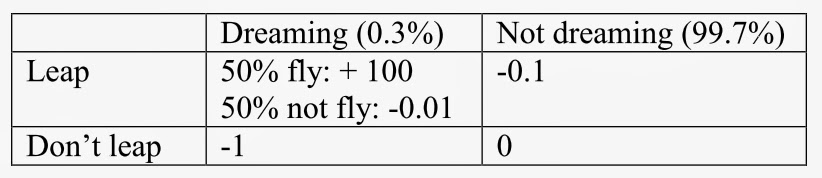
Plugging into the expected value formula:

Leap = (.003)(.5)(100) + (.003)(.5)(-0.01) + (.997)(-0.1) = approx. +.05.

Not Leap = (.003)(-1) + (.997)(0) = -.003.

Leap wins!

Of course, this decision outcome is highly dependent on one’s degree of confidence that one is awake, on the downsides of leaping if it’s not a dream, on the pleasure one takes in dream-flying, and on the probability of success if one is in fact dreaming. I wouldn’t recommend attempting to fly if, say, you’re driving your son to school or if you’re standing in front of a class of 400, lecturing on evil.

But in those quiet moments, as you’re walking along doing nothing else, with no one nearby to judge you — well maybe in such moments spreading your wings can be the most reasonable thing to do.

[Cross-posted at The Splintered Mind.]

Posted in ,

14 responses to “Should I Try to Fly, Just on the Off-Chance That This Might Be a Dreambody?”

  1. Chris Ruth Avatar

    That’s also a good method for lucid dreaming, as you will begin doing the test in your dreams if you do it often enough while awake.

    Like

  2. Shecky R Avatar

    Well, I’ve done this myself in the past! …and now I feel I can say that out loud, knowing that someone ELSE has self-reported it 😉
    I too fly frequently and awesomely in my dreams, and it certainly feels utterly real and convincing… until I awake.

    Like

  3. Carolyn Dicey Jennings Avatar

    The leap can also serve as a test of your flying abilities if you are not sure whether or not you can fly. Imagine that you have had flying dreams and think it likely you can fly in the real world just as you do in your dreams, but also recognize that other people don’t normally fly and that this might be because most people can’t fly. In that case, a leap when you are not dreaming should be split into “fly” and “not fly.” The probability of each is probably around 50% for anyone that considers this a real test, but the outcome is probably close to at least -100 for “not fly,” since it would be such a let down to find out that this ability is limited to your dreams. Let’s call it 1 for “fly,” since it probably wouldn’t actually add that much to your well-being to fly in the real world. In that case, if it is pretty likely you aren’t dreaming then you should probably keep your leaps to yourself.

    Like

  4. Eric Schwitzgebel Avatar

    @ Chris: I agree, but I didn’t want to stack the deck too much on the upside!
    @ Shecky: Let’s try it together sometime.
    @ Carolyn: Well, you weight things rather differently than I! But as long as you’re applying decision theory with a column for the dream-possibility, I’m good with your keeping your feet on the ground.

    Like

  5. John Smith Avatar
    John Smith

    humans can’t fly.
    “since it probably wouldn’t actually add that much to your well-being to fly in the real world.”
    it would. not using cars anymore, or walking long distances. easier.
    I think he felt enthusiastic or had an idealistic/romantic phase and felt like flying.
    it is normal, and not harmful.
    if I am not missing something.

    Like

  6. Carolyn Dicey Jennings Avatar

    Even if humans can’t in fact fly, some people applying the decision matrix might not realize this (e.g. 5 year olds). In that case, the entries in the columns would be different. It turns out that the numbers are quite different if you add more substantial numbers to the “not dreaming” column because the probability you are not dreaming is so high. So my point is that for such a person it might be worthwhile not to leap, since to leap is to risk finding out that, as you put it, “humans can’t fly.” Even if the value of flying in the real world is greater than 1, so long as it is less in magnitude than the let-down of finding out you can’t fly, it drives a different result (e.g. -100 and 99 yield -.34, which is worse than -.003…so you shouldn’t leap!). I like Eric’s post, which I found funny and playful…mine is meant to be a response in kind.

    Like

  7. John Smith Avatar
    John Smith

    on second glance at Eric’s post, I realized that he was actually interested in dreaming, as a subject, since he was heading for the library to get some books on dreaming.
    it seems to be important. not really a romantic phase, but a serious quest about an interesting subject.
    we ca fly in our dreams, although I was never like a bird in any of my dreams.
    I don’t see myself as a bird. I do like the flying ability as well.
    children believe in extraordinary things as being normal or natural.
    this can be dangerous as well.
    you can leap, as you said it, but if you leap from a mountain or a high building, it’s suicide.
    I think humans have always been fascinate with birds and their ability to fly.
    and we just can’t fly, as simple as that. as simple as birds can fly.

    Like

  8. John Smith Avatar
    John Smith

    so if you are dreaming, you are most likely capable of flying. not always though, not in any dream?
    some requirements.
    but what if this is a Matrix, this world, this planet, and we all dream?
    we could do anything or only some things. we assume that we have absolute freedom in our dreams, and I do not really believe that.
    or a dream within a dream. I dream and I go to sleep to dream flying, but when I wake up from dreaming that I am flying, I am still dreaming but I am not capable of flying.
    do birds dream that they can not fly?
    I envy them. Just for this ability.

    Like

  9. John Smith Avatar
    John Smith

    I tend to think that we do not have absolute power in our dreams. We are doing other things that seem impossible to do when we are awake but that does not mean that we posses more freedom than we posses when we are awake. It does not seem to be plausible to conclude this.
    if I am dreaming right now that I can fly or that I can not fly, the difference between them is that I actually want to be able to fly. In the dream, the one that I dream when I go to sleep but I do not know that I am dreaming it ( if it is a deep dream ), I think of trying to fly and I actually fly. No puzzling about it.
    When I am awake, I think about flying and trying to fly in vain.
    this leads me thinking that I have more freedom of action or mind in my dreams. My body is not real though there.
    When I am awake, I simply know that humans can not fly. No one can do this on this planet.
    Maybe some were able to, to begin with ( why not ? ) but since there were so many people unable to and discouraging about it, it became a fact. No human can fly.
    This is a sort of a science fiction scenario, but I like it to some extent.
    I do believe in dreaming while awake and not being aware of it. And that means being powerless.
    In Matrix, being outside Matrix meant knowing how things really were in reality and also having a shock because of that. Or being depressed.
    In Matrix, Cypher only wishes to go back to the Matrix and to the dream like reality and knowing that when he is eating a steak, he is really eating a steak.
    We want to be happy and do things that we like, as flying seem to be ( besides being useful ), but we simply do not know why we can do more when we sleep than when we are awake.
    And I still believe that we are not that free when we dream. That is still a persistent illusion.

    Like

  10. John Smith Avatar
    John Smith

    are we less connected to other people in our dreams and more alone than we are when we are awake?
    does this make us more capable of the impossible things we can do when we dream?
    why not?
    when I am awake, I am very aware of what is normal and what is not, of what other people are doing and what the limits are. and if I set my mind that there is a limit, then I will fulfill that dream of mine. My mind is not always a friend of mine when I am awake.
    of course, besides the fact that there are real limits.

    Like

  11. Eric Schwitzgebel Avatar

    John, these are all fascinating issues! Obviously, I can’t address them all here, but I agree that dreams are one interesting way into issues about skepticism and human capacity.

    Like

  12. Patrick S. O'Donnell Avatar

    By way of the idea that “dreams are one interesting way into issues about skepticism and human capacity”:
    The use of “dream arguments” in Indic philosophy is rather intriguing (apart from the provocative treatment of ‘lucid dreaming’ in Indic tantric yoga and Tibetan Buddhism) and I’ll all-too-briefly introduce them. Eliot Deutsch reminds us that in the Advaita Vedānta school of classical Indic philosophy, “a good deal of importance [is attached] to the phenomenology of dream consciousness [svapna-sthāna] in order to show the continuity of consciousness and the persistence of self-awareness throughout all states of consciousness.” In addition to the states of consciousness associated with the waking state and the dream state, there is the third state of consciousness found in “deep sleep” (susupti). Only turīya (lit., ‘the fourth’), the fourth state of consciousness recognized by Vedānta, is characterized as the “transcendental” or a “pure” state of consciousness. Later in the tradition, we find not one but two states of consciousness beyond deep sleep [reminiscent of the highest states of consciousness in Patañjali’s Yoga Sūtra]: savikalpa samādhi and nirvikalpa samādhi, the former still a “determinate” spiritual experience, “but unlike in susupti, the deep-sleep state, the emphasis here is not so much on the absence of duality as it is on the presence of non-duality.” This might be described as a liminal state betwixt and between the jīva and the Ātman, the devotee jñāna-yoga poised on the precipice, as it were, of the meditative realization of nirvikalpa samādhi, the awareness of nirguna Brahman.* As Eliot Deutsch explains, the waking and dreaming states of consciousness correspond to the phenomenal world of gross and subtle bodies; the states of deep sleep and savikalpa samādhi correspond to saguna (‘qualified’) Brahman, while turīya or transcendental consciousness and nirvikalpa samādhi correspond to Ultimate Reality or nirguna Brahman (recalling the equation Ātman = Brahman). Just as the dream state is “subrated” (disvalued, contradicted, and transcended) by the state of waking consciousness, so too nirguna Brahman, as “ultimate reality” subrates all prior experience, while nothing else is capable of subrating Brahman, defined as spiritual experience utterly bereft of distinction or determination (nirvikalpa samādhi), and described as an immediate (hence unmediated) consciousness or awareness on the order of complete or absolute self-knowledge and self-realization.
    As Chakravarthi Ram-Prasad has written in his discussion of Advaita Vedānta epistemology and metaphysics (as an exemplar of Indian ‘non-realism’ against the ‘idealism’ of some Buddhist philosophers, the latter arguing that ‘no world extrinsic to the cognitive exists’), Vasubandhu, a Yogācāra (or Vijñānavāda) Buddhist, argued that dreams were evidence of the possibility of experience without an external world. Vasubandhu’s use of argument from the dream analogy, while resembling Descartes’ later use of it in his Meditations, is significantly different from it insofar as he does not allow the realist assumption that Descartes begins with by way of later arriving at a skeptical conclusion (‘the Cartesian concern is with how systematic perception of the external world is achieved; the Vijñānavādin’s concern is with the very coherence of the idea that perception is systematically of an external world’). Śankara, the Advaita philosopher, “provides a refutation of this argument, based on its inability to meet the requirements (accepted by Vasubandhu!) of the pramāna theory for knowledge. Vasubandhu’s crucial move in his use of the analogy of dreaming is to point to the lack of externality in dreaming when the experience of dreaming otherwise resembles that of waking. Śankara points out a fallacy in this form of reasoning. In order to deny externality in dreaming, Vasubandhu borrows the concept of it from waking in the first place, and so cannot deny it altogether. [….] Śankara also has a wider argument against any idealist denial of externality in the account of experience. He points out that externality is a feature of experience [within the domain of ‘provisional reality’ in light of nirguna Brahman], and while an idealist account may reduce every other feature of experience to a mental construct without losing its claim to be veridical, the same cannot be said of externality. Reducing the feature of externality to mental construction results in denying that that feature of experience is veridical. So experience cannot be entirely veridical in seeming to be of an external world, if the idealist is correct. But the idealist does want to say that experience is veridical, even if mentally constructed; in this he differs from a sceptic who denies that experience is veridical. Śankara’s argument shows that idealism cannot but collapse into scepticism about the external world. However, Śankara does agree that dreaming has a role to play: it alerts one to the possibility that this current experience may be overruled [‘subrated’] by some other type of consciousness. [….] It has been observed that dreaming itself can make sense only in the context of being awake. There must in general be veridical experience for error to occur; there must be real coins for there to be counterfeits.” [….]
    “Nothing that is available in our experience, that is to say, no knowledge-claim which can meet the standards of the pramānas, allows us to claim that what is currently experienced can never be invalidated. This is the real lesson of the analogy of dreams. Dreams teach us that even within a consistent system for the validation of knowledge-claims, nothing in what is experienced will license the non-invalidable assertion that what is currently experienced is the sole reality. Consequently, the soteriological claim, that this world is indeed subsumed by the reality of Brahman, cannot be gainsaid. The system for the validation of claims arising from experience itself derives its authority from what is experienced. The system of validation is legitimately applicable so long as that to which it is applied is the very same experienced world from which the system’s authority is derived. Since the pramāna theory is understood as being about the world from which its causal authority is derived, the legitimacy of the theory is limited to the currently experienced world. If all claims are valid or invalid because they succeed in or fail the tests of the pramāna theory (the system of validation), the validity of experiential claims is circumscribed by their being about the world that is experienced. The reality putatively behind the world [i.e., nirguna Brahman] would legitimately and coherently be known only according to standards derived from it—but those standards, the standards of the liberated self [i.e., Ātman]—are currently unavailable to ordinary subjects.”
    * For a cursory online introduction to Advaita philosophy please see here: http://ratiojuris.blogspot.com/2012/02/advaita-vedanta-philosophy-introduction_21.html

    Like

  13. Patrick S. O'Donnell Avatar

    Incidentally (or perhaps not), those interested in further exploration of “dreams and dreaming” (philosophical or otherwise) may find use of my bibliography for same: https://www.academia.edu/4844012/Dreams_and_Dreaming_bibliography

    Like

  14. Eric Schwitzgebel Avatar

    Thanks, Patrick, for that introduction to some of the work on dreaming in Indian philosophy! As it happens, some of the material that I had been reading in the time before this post was from Evan Thompson’s new book in draft, which brings together work in Indian and Buddhist philosophy with contemporary scientific dream research and his own experiences in dreaming and meditating. It would be nice to see more of that material brought into the Western philosophical mainstream.

    Like

Leave a reply to Patrick S. O’Donnell Cancel reply