I have a new theory of the jerk, just out in Aeon.
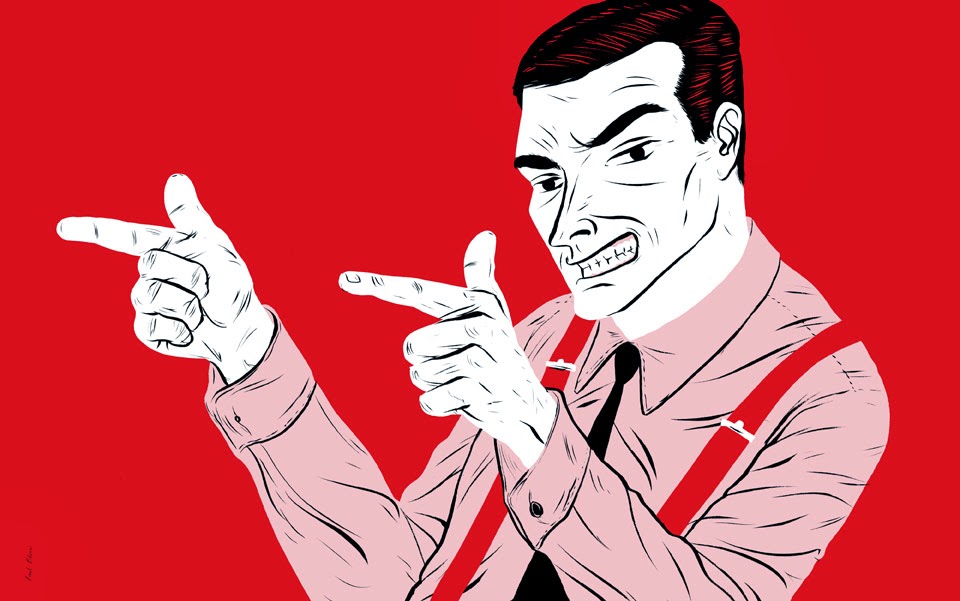
The piece uses the term “idiot” in several places to characterize how the jerk sees the world: “I’m important, and I’m surrounded by idiots!” In light of Shelley Tremain‘s remarks to me about the history of the word “idiot”, I’m wondering whether I should have avoided it. I’d be interested in the thoughts of NewAPPS folks about this. In my mind, it is exactly the sort of word the jerk is prone to use, and how he is prone to think of people — and of course he thinks of people in offensive ways and won’t be bothered by offensive terms unless that’s his particular moral high horse. So there’s a conflict now between my desire to capture the worldview of the jerk with phenomenological accuracy and my newly heightened sensitivity to the historical associations of that particular word.

[illustration by Paul Blow]

Posted in

15 responses to “A Theory of Jerks, and a Query about the Term “Idiot””

  1. Richard Avatar
    Richard

    Where can one find Tremain’s remarks about the history of the term? (It’s not obvious which of the papers on her academia.edu page discusses it.) I wouldn’t say that historical associations of a word are never relevant to whether they should be used today, but it’s not clear to me that they’re always relevant either, so I would like to know more about this particular case.

    Like

  2. Eric Winsberg Avatar
    Eric Winsberg

    There are two issues here, of course,
    The first is that the offensiveness of offensive language often scopes out. Included in this is that one can often often just by mentioning an offensive term. The second is that almost every derogatory term has some unsavory history. Over on facebook I just saw someone argue, (not very persuasively to me, but that’s not really the point) that the term “jerk” is offensive because it implies that masturbation is shameful and that this is in some way misogynistic (I cant remember the full story–maybe Ed can reconstruct it.) I think the two points are intertwined because a choice of whether or not to mention an offensive term in a context where the particular term is important depends on just how offensive the term is. What surely matters most is what impact the term actually has on its hearer, not what it would have if the majority of hearers if they were aware of its history.

    Like

  3. Shelley Tremain Avatar
    Shelley Tremain

    Richard is correct that the history of the term ‘idiot’ is not the distinct focus of any of the articles on my academia.edu page. I do, nevertheless, discuss some of the sordid history of the terms ‘idiot’ and ‘imbecile’ in my article “Educating Jouy” which can be viewed here:
    https://www.academia.edu/5812094/Educating_Jouy_A_case_study_of_ableism_in_feminist_philosophy_ or downloaded from my academia.edu profile page here: https://independent.academia.edu/ShelleyTremain.
    Much has been written about the ableist, racist, classist, and sexist history of the term ‘idiot,’ as well as terms such as ‘moron,’ cretin,’ ‘feebleminded,’ and ‘imbecile.’ Here are a couple of recommendations:
    Trent, James W., Jr., 1995. Inventing the Feeble Mind: A History of Mental Retardation in the United States. Berkeley: University of California Press.
    Carlson, Licia. 2009. The Faces of Intellectual Disability: Philosophical Reflections. Indianapolis: Indiana University Press.
    The bibliographies of both of these books can direct readers to additional valuable material on the topic.

    Like

  4. Eric Schwitzgebel Avatar

    Richard: Tremain pointed me to her “Educating Jouy” and to “Metaphorically Speaking” in the Disability Studies Quarterly. Both have brief discussions of “idiot”, but not a lot of detail. I also recall discussion in Gould’s Mismeasure of Man, which convinced me years ago to abandon “moron” which was specifically and recently invented as an oppressive category. I also consciously avoided “moron” in the Aeon piece, because it seemed like other terms would do well enough.
    Perhaps “idiot’s” history is sufficiently similarly offensive to merit similar treatment — but I do need to put some words in the mouth of the jerk, and as Eric W. says pretty much every offensive term has a problematic history of some sort. A friend of mine in disability studies who knows quite a lot about the history of these things, has pointed out to me that “dumb” and “fool” also have problematic histories (maybe not as bad as “idiot”) and suggests “f*ckwit” as a perhaps the safest choice — but it’s hard for me to see going entirely there, partly since the f-word isn’t my cup of tea (both because of its perception as one of the most obscene words in the language and also because it reinforces negative associations with sex) and partly because it requires some, I think, phenomenological distortion to make that the term of choice of the archetypical jerk.
    I’m still uncertain about these issues. I do think that I would have written the piece a little differently if I were starting it fresh today.

    Like

  5. Eric Schwitzgebel Avatar

    Eric W: Thanks. I agree with both of your points. Pretty much every commonly used insult does have an unsavory history of some sort. So part of the question is how unsavory and how close to the surface for the audience. And I also agree that mentioning the term in a critical context is not ordinarily a problem, while using it uncritically is a problem — my piece is perhaps an intermediate case, since I’m not quite doing either of those things but rather putting the term in the voice of someone who is supposed to be viewed as an unappealing character in part because of his use of that very term. There are certain words that I would be very cautious doing this with, and so the question is whether “idiot” should be among them.
    On sexual associations: As I mentioned in my reply to Richard, I tend to dislike insults that reinforce negative associations with sex and genitalia — and some people seem to hear “jerk” that way, even in its noun usage. In my mind, that is a downside of the term. But I wanted a high-use term that was not regarded as obscene and had a (comparatively!) unproblematic history, and I didn’t want to wrestle with Aaron James over “asshole” — so “jerk” seemed like the best compromise.

    Like

  6. Eric Schwitzgebel Avatar

    Thanks again, Shelley. Let me just mention that I hadn’t yet seen your reply to Richard when I composed my own reply.

    Like

  7. Jamie Dreier Avatar

    Eric, surely the word you want is ‘asshole’. No?

    Like

  8. Eric Schwitzgebel Avatar

    Jamie, I see some merits in that term, for the lack of sexual connotations. However, Aaron James already has “asshole”:
    http://www.amazon.com/Assholes-A-Theory-Aaron-James/dp/0385535651
    James’s theory of assholes is interesting, and rather than compete for the term, I think there’s room for a few related terms.
    Also, “asshole” isn’t really part of my active vocabulary, so I’m not entirely comfortable exploring its nuances. Though it might seem quaint, I retain a certain prudish aversion to words that were censored from U.S. television when I was growing up. I actually think that retaining an aversion to them adds a dimension of power to the language, as I discuss in this old post:
    http://schwitzsplinters.blogspot.com/2007/09/forbidding-fuck-and-shit-to-save-them.html

    Like

  9. jdkbrown Avatar
    jdkbrown

    How about “doofus”? Or “dumbass”? The latter incorporates the perhaps problematic “dumb,” but its usage is distinct enough that, at least to my ear, it just doesn’t have the same connotations.

    Like

  10. Eric Schwitzgebel Avatar

    Thanks jdkbrown. “Bonehead” also strikes me as potentially useful in this context.

    Like

  11. Charles R Avatar
    Charles R

    As the circle of people whom the jerk is willing to regard as true peers and superiors shrinks, so does his capacity for shame – and with it a crucial entry point for moral self-knowledge.
    Your argument sets up for the word you’re looking for: shameless. Use it as a noun.
    Shame is the insight, the opening, into moral knowledge about one’s self in relation to others. We let glory be something one does with one’s self, and we pay the price for allowing that. But shaming one’s self is something we allow especially when others feel the same way, meaning the idea necessarily brings in our relationship with others as defined from their perspective. To have shame, to conceive it as an idea, we must think about that other perspective and then think from that other perspective. The canonical model of shame demands intersubjectivity and transposition within it. But tellingly, shame’s truth depends not directly on the truth about facts (whether you did it or not), but a truth about our relationships (whether you see it as they see it as you having done it). Glory we let be reflexive; it’s model just of the one subject; and valued only when it is a truth about facts, or you did do what you’re taking credit.
    Someone shameless does not see it from others’ perspectives and does not think they did it. I read your argument as articulating being a jerk fits those two points. So, a jerk is one of the shameless. How does this sound?

    Like

  12. Eric Schwitzgebel Avatar

    Cool, Charles R. I think of one of my favorite moral psychologists, Mengzi, who says that shame is the sprout which — if we notice and reflect on it — grows into grows into the virtue of being righteous (yi).
    Bryan Van Norden:
    http://link.springer.com/article/10.1007%2FBF02856995#page-1

    Like

  13. Richard Avatar
    Richard

    Eric S.: What do you think about the word ‘boob’ (as used to refer to a stupid person)? Does it count as having a sexual connotation even if its etymology has nothing to do with female breasts?

    Like

  14. Eric Schwitzgebel Avatar

    Richard: “Boob” isn’t really in my normal productive vocabulary, nor do I hear it much in my usual social circles, though certainly I am familiar with that usage. Not sure about the sexual connotation. I hear the sexual stuff nearer the surface of “that’s guy’s such a boob” than I do for “that guy’s such a jerk” — but that might be idiosyncratic.
    It would be interesting to do some work some time on the sexual dimension of insults. I don’t really know much about it, but I bet there’s some pretty interesting work on it out there!

    Like

  15. Eric Winsberg Avatar

    I’ve always thought of the prototypical “boob” as being Thomas Friedman.

    Like

Leave a comment