
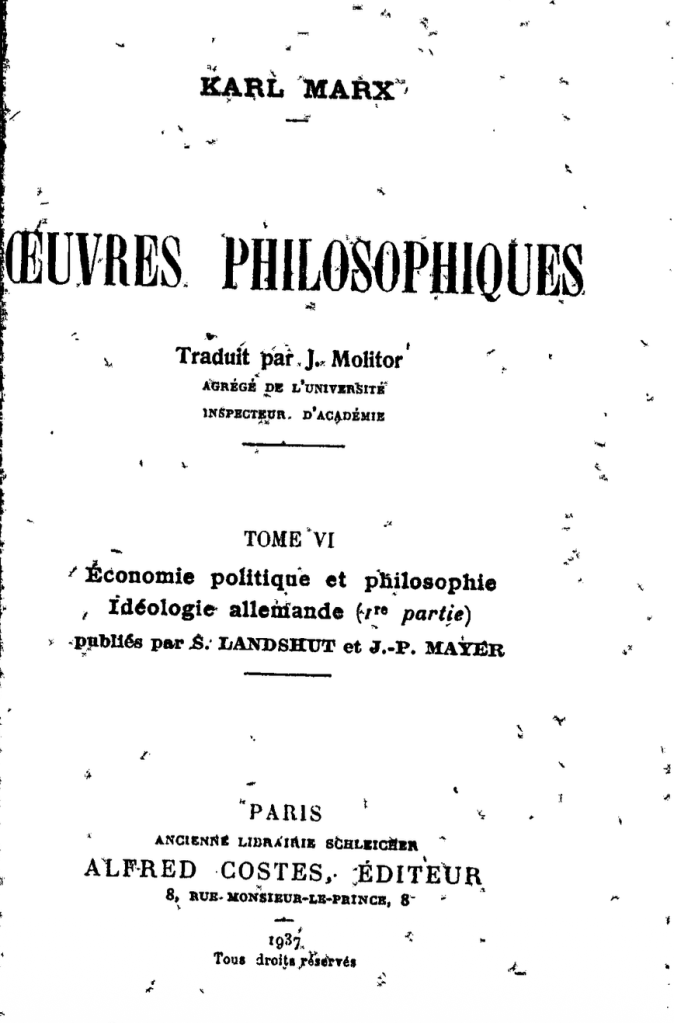
Foucault’s Question Anthropologique, a course on anthropology that he gave at Lille in 1954-5, contains a detailed reading of Marx. Foucault’s unpublished papers contain detailed notes on Marx from roughly the same period, as Jean-Baptiste Vuillerod indicates. The notes help with two textual points. First, Foucault was reading the edition of Marx’s Œuvres philosophiques translated by Jules Molitor. Unlike, for example, his reading of Heidegger, Foucault does not seem to have studied Marx in German (at least not at this stage). Second, Foucault takes The German Ideology to be decisive in Marx’s development, writing in his notes “Thèse: L’Idéologie allemande serait le premier texte matérialiste; les autres seraient encore philosophiques” (see the discussion in Vuillerod; a scan of the page is here). The most important text to understand for Foucault’s reading of Marx, then, is contained in Molitor’s Volume 6, which contains the German Ideology and the 1844 Manuscripts. Alas, the more I look at the Molitor volume, the stranger it becomes.
Let’s start with the German Ideology. This text is a mess to begin with; as Terrell Carver argues, the first part – “On Feuerbach,” which contains Marx and Engels’ first real statement of historical materialism – wasn’t so much a product of Marx and Engels’ as a reconstruction by the Soviet Marxologist David Riazanov, and Riazanov had his own agenda. On the one hand, he was committed to textual fidelity to Marx and Engels’ works, recovering and publishing archive materials. He was also the editor of the original Marx-Engels Gesamtausgabe collected works, at least until Stalin had him deposed. On the other hand, he was ideologically opposed to the canonization of Lenin as a revolutionary theorist (as opposed to practitioner). This was unfortunate: on the emerging Soviet orthodoxy that began shortly after Lenin’s death, Marx-Engels broke decisively with Hegel; Lenin advanced decisively over Marx; and Stalin advanced over Lenin. Manuscripts that showed a heavy engagement by Marx and Engels with people like Feuerbach would complicate that narrative, as would evidence of their taking Hegel seriously (hence the need for the argument that they broke with their early “philosophical” work). Thus Riazanov, who was eventually hauled off and shot for his troubles. In any case, suffice it to say that L’idéologie allemande that Foucault was reading wasn’t attending to any of this later complication about the text.
What caught my eye, and which lead to a substantial rabbit hole, were some of Molitor’s translation choices. Consider what Marx and Engels say at one point about alienation. Here’s some different versions. MECW is Marx-Engels Collected Works; Molitor is Molitor; MEW is the German in the Marx Engels Werke. I’ll give you a good sized chunk of the MECW first for some context, then zero in on the first sentence.
MECW: “This “estrangement” [“Entfremdung”] (to use a term which will be comprehensible to the philosophers) can, of course, only be abolished given two practical premises. In order to become an “unendurable” power, i.e., a power against which men make a revolution, it must necessarily have rendered the great mass of humanity “propertyless”, and moreover in contradiction to an existing world of wealth and culture; both these premises presuppose a great increase in productive power, a high degree of its development. And, on the other hand, this development of productive forces (which at the same time implies the actual empirical existence of men in their world-historical, instead of local, being) is an absolutely necessary practical premise” (MECW IV, 48-9; the parenthetical “Entfremdung” is included in the translation).
That is, the Hegelian sublation depends on material conditions, and not the other way around. This in turn means that the “proletariat can only exist as a function of universal history” in the sense of the “existence belonging to universal history, that is to say the existence of individuals directly attached to history.” This is a pretty good example of inverting Hegel’s idealism. Now let’s look at the first sentence:
MEW: “Diese „Entfremdung”, um den Philosophen verständlich zu bleiben, kann natürlich nur unter zwei praktischen Voraussetzungen aufgehoben werden.” (MEW III, 34).
Molitor: “Cette extériorisation, pour demeurer intelligible aux philosophes, ne peut naturellement être supprimée que, dans deux présuppositions pratiques” (Molitor VI, 176).
What is the choice to render “Entfremdung” as “extériorisation” rather than the more negative “aliénation?” (current English editions, like the one in Early Writings render Entausserung as “alienation” and Entfremdung as “estrangement.” Estrangement has a negative sense). In Hegel, there’s two terms. There’s Entaußerung, which can have a positive connotation. Then there’s Entfremdung, which is always negative. In an older paper, Philip Kain lays out the basic distinction this way:
“For Hegel alienation means a surrender by a subject, a giving up of essential being. What is given up may take the form of an external independent object – but it need not always do so. When it does, it may result in estrangement. Here the object turns against the subject as a hostile, objective power with an independent life of its own. Any case of estrangement presupposes alienation. But, for Hegel, all cases of alienation by no means result in estrangement” (139).
For me, by far the easiest to understand case of positive alienation in Hegel is in the discussion of private property in Philosophy of Right. There, Hegel argues that:
“The person must give himself an external sphere of freedom in order to have being as Idea. The person is the infinite will, the will which has being in and for itself, in this first and as yet wholly abstract determination. Consequently, this sphere distinct from the will, which may constitute the sphere of this freedom, is likewise determined as immediately different and separable from it” (sec. 41; p. 73 Cambridge ed.).
Before I alienate my will into the world, my will is abstract. I put it into objects and the reconciliation of this – what prevents it from becoming estrangement – is that those objects that bear my will become part of my personality, which is now extended into the world. Property is the word for this. Thus:
“A person has the right to place his will in any thing. The thing thereby becomes mine and acquires my will as its substantial end (since it has no such end within itself), its determination, and its soul – the absolute right of appropriation which human beings have over all things” (75).
And: “Property becomes the personal aspect of this specific will. Since I give my will existence [Dasein] through property, property must also have the determination of being this specific entity, of being mine” (78).
For me, a clear example is the proverbial moment of when a house becomes a home. When I put up my stuff in the place, I inhabit it; when I buy objects that express my personality and place them there, it becomes my space. And it’s super alienating in the bad sense to live very long in a place where nothing is yours.
As for estrangement in Hegel, Kain cites a few sections in the Phenomenology, as for example the section “Legal Status” where the Roman emperor contains all power and confronts atomic individuals who retain no power. The hostile relation between the two is estrangement.
In any case, all of that suggests that the translational decision is potentially significant. It is not clear that Marx distinguishes between the terms, at least not consistently, so there’s an interpretive question on top of the translational one. Kain says that he does, at least some of the time. I agree, though I’ll take it up next time.
So I decided to look for other instances of the term in Molitor. The short version is the Molitor elsewhere is pretty consistent as in rendering Entausserung/Entfremdung as extériorisation/aliénation, at least in the somewhat unscientific sample of passages I looked at. So the passage that caught my eye may well be an outlier, with the asterisk that I haven’t conducted a particularly thorough search.
But it took a while to get there, because I immediately ran into the textual history of the 1844 Manuscripts. These had their own peculiarities, as documented by Michael Maidan. Unknown until Riazanov discovered them, they were first published in the 1920s and 1930s. Maidan reports:
“It was only in 1927 that a selection of the Paris Manuscripts was published in a Russian translation under the title ‘Preparatory Materials for the Holy Family.’ The selection, consisting of a fragment of the third manuscript, was reissued in the 1929 Russian edition of the collected works of Marx and Engels. The same text was edited, this time in German, in 1929. The first complete edition of the Manuscripts appeared in 1932, this time in two editions, each produced in a completely different spirit. What seems to have been the first edition, and is also reputed to be the less reliable, was published in Germany by S. Landshut and J. P. Mayer. It was followed closely by the MEGA edition.” (768)
The text contains three manuscripts. The MEGA edition contains all three. Landshut and Mayer’s edition was incomplete. It “starts with the Preface, like MEGA … but then continues, with no division or editorial comment, with selections from the third manuscript, and from the second. Even a cursory examination shows that this edition should be considered rather as ‘morceaux choisis’ than a complete edition of the Manuscripts.” (770).
Naturally, Molitor is based on Landshut and Mayer. The texts are different enough that I had to be convinced that Molitor actually contained the 1844 Manuscripts, because I kept looking for the section on alienated labor. Turns out that’s in the first manuscript, which isn’t there. I tried looking for information on Molitor, and turned up almost a complete blank other than as a French translator of Marx. The title page says he’s an Agrégé and an “inspecteur d’académie,” which basically means he was a civil servant within the French educational system. I set Claude to work, and it came up with the tidbit that the inclusion of Riazanov’s editorial work on the front pages of many of his editions suggests that he worked closely with Riazanov. Unfortunately, Molitor’s translation of the 1844 Manuscripts was prepared after Riazanov’s purge (the date on the edition is 1937; Riazanov was dismissed from his post as director of the Marx-Engels Institute in Feb. 1931, sent to Saratov later that year, and executed in early 1938).
Tl;dr: if you’re studying somebody from the mid-20c in Europe and they’ve been reading Marx, you not only need to know which Marx (early vs. later). You also need to know what editions. Here, for example, it looks like Foucault likely did not read the sections on alienated labor in the 1844 Manuscripts.
Next time I’ll say something about Marx’s distinction between alienation and estrangement, because I do think he makes it, at least when he’s reading Hegel.


Leave a Reply