
Philosophers' Carnival #158 is HERE.
recent posts
about
-
(Cross-posted at M-Phi)

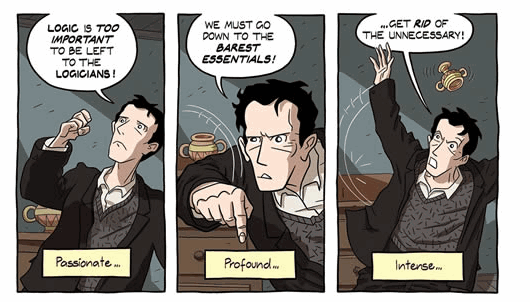
( From the graphic novel Logicomix, taken from this blog post by Richard Zach.)
“He doesn’t want to prove this or that, but to find out how things really are.” This is how Russell describes Wittgenstein in a letter to Lady Ottoline Morrell (as reported in M. Potter’s wonderful book Wittgenstein's Notes on Logic, p. 50 – see my critical note on the book). This may well be the most accurate characterization of Wittgenstein’s approach to philosophy in general, in fact a fitting description of the different phases Wittgenstein went through. Indeed, if there is a common denominator to the first, second, intermediate etc. Wittgensteins, it is the fundamental nature of the questions he asked: different answers, but similar questions throughout. So instead of proving ‘this or that’, for example, he asks what a proof is in the first place.
-
When I was an undergraduate at the University of Texas in the late 80s there was the huge fad of philosophers making fun of professors in other departments who had appropriated philosophical thinking for their own projects.
Honestly, it's pretty easy work for people who spend their lives just studying philosophy to beat up on our brothers and sisters in humanities departments when they enter into conversation with a philosopher. The trick is to bracket the dialectical context of the appropriation as well as treat the norms relevant for engaging in those debates as if they are the same as writing good philosophy. With literarature department deconstructionism, this meant completely ignoring the context of New Criticism and the contribution that the appropriation of Derrida and De Man's writings made with respect to this background.
As a result of the kind of methodological stupidity the revolution very quickly began eating its own,* culminating perhaps in the 1992 petition against awarding Jacques Derrida an honorary Cambridge doctorate. By this point it was clear that American philosophy had completely squandered a very real chance of retaining a role as queen of the humanities. If during theory's heyday, a critical mass of us had actually taken the time (a couple of years hard work in each case) to actually immerse ourselves in the relevant history and canonical texts of other departments doing "theory," philosophy would today widely be viewed as a helpful discipline, as opposed to this weird thing where we spin our own wheels.**
One of the most depressing things to me as a student of continental philosophy is to see how the worst aspects of the the analytic/continental rift are now being replicated within continental philosophy.
-
My Mom taught in a prison in the mid 1980s, which was a weird era in lots of ways.
The movie War Games had come out in 1983, and inmates as a result had very strange views about what computers could and couldn't do. Even though none of the prison computers at that point were even hooked up to ARPANET, about once a week an inmate would sneak off and get a computer and desperately try to wreak as much havoc as Mathew Broderick does in the movie, just typing pages and pages of nonsense, usually in the hope that early release could be secured but sometimes to try to launch thermonuclear warheads. It really was a very strange time to be incarcerated, alive, and computer illiterate. One could just type nearly random symbols and the machine was supposed to make proper sense of it.
Sadly, I just remembered all this stuff because I'm grading logic finals today. The twenty-teens are apparently also a weird era.
-
Last week, I wrote about Tennessee's unprecedented push to execute 10 prisoners, beginning on January 15, 2014.
Today, I'm happy to report that the January 15 execution of Billy Ray Irick has been postponed to October 7, 2014. Why? Because of legal challenges to Tennessee's new lethal injection protocol.
Next week, I will fill in the context for this legal challenge, but this week, I want to bring your attention to an open letter by Tennessee Students and Educators for Social Justice, which calls on Governor Bill Haslam to suspend all scheduled executions immediately, and to commission a full and transparent review of capital punishment in Tennessee.
The letter has been signed by almost 300 students and educators from colleges, universities, and high schools across Tennessee, and a companion petition has been signed by over 300 additional supporters. Everyone is encouraged to sign the petition! If you study or teach in Tennessee, you are welcome to add your name to the open letter.
The letter is reproduced in full below. Please share with your colleagues and students!
-
While reading this recent KCNA article about the execution of North Korean dictator Kim Jong-Un's uncle, I was really struck by just how transparently stupid the thing is from beginning to end. It never really tells you what the uncle did that was so bad, but just accuses him of broad classes of sin:
The accused Jang brought together undesirable forces and formed a faction as the boss of a modern day factional group for a long time and thus committed such hideous crime as attempting to overthrow the state by all sorts of intrigues and despicable methods with a wild ambition to grab the supreme power of our party and state.
The closest it ever gets to actually specifying anything is when it says that Jang didn't clap enthusiastically enough at one meeting!
When his cunning move proved futile and the decision that Kim Jong Un was elected vice-chairman of the Central Military Commission of the Workers' Party of Korea at the Third Conference of the WPK in reflection of the unanimous will of all party members, service personnel and people was proclaimed, making all participants break into enthusiastic cheers that shook the conference hall, he behaved so arrogantly and insolently as unwillingly standing up from his seat and half-heartedly clapping, touching off towering resentment of our service personnel and people.
Clearly this functions to get people in line so as to be enthusiastic in their public displays of affection for dear leader. But I think there's something more universal going on in the whole piece.
It should be clear that bludgeoning people into publicly acquiescing to transparent stupidity is a powerful way to make them complicit in their own immiseration. Orwell came very close with the 2+2=5 thing, but he didn't quite get it. It's much more subtle and powerful. The linked to article doesn't state any mathematical falsities, but just insults the intelligence through vagueness, unsubstantiated insults, and insults that presuppose ridiculous world views ("thrice cursed dog" etc.).
I think this kind of thing is much more common than we presuppose. For example, even to be able to talk about Obamacare in many contexts you have to go along with the presupposition that private insurance for health makes sense in the first place. Or when you are at an assessment meeting at your University, you just have to go along with a lot of pernicious, false presuppositions even just to discuss how to use the newest interation of the unhelpful web interface. Or consider Protevi's recent expose of a bit of utterly typical administrative newspeak.
Just to get along and navigate basic things in life you have to communicate as if a bunch of stupid nonsense actually makes sense.
Obviously this trope is used to much more destructive effect in North Korea (mass starvation, intergenerational gulags, etc.) but I'm not sure that our own public discourse is any less ridiculous than that of the KCNA. Jello Biafra is perhaps our saving grace on this score.
-
Nice article here about Henry Markram's theoy of autism as "intense world syndrome," which entails that:
The behavior that results is not due to cognitive deficits—the prevailing view in autism research circles today—but the opposite, they say. Rather than being oblivious, autistic people take in too much and learn too fast. While they may appear bereft of emotion, the Markrams insist they are actually overwhelmed not only by their own emotions, but by the emotions of others.
Consequently, the brain architecture of autism is not just defined by its weaknesses, but also by its inherent strengths. The developmental disorder now believed to affect around 1 percent of the population is not characterized by lack of empathy, the Markrams claim. Social difficulties and odd behavior result from trying to cope with a world that’s just too much.
-
This week’s post is again not entirely Brazilian, technically speaking: today we have Cape Verdian young singer Mayra Andrade, who some of my friends have been raving about for a while (Jeroen and Rafa, that's you!). What justifies her inclusion among the BMoF guests is not only the fact that most of her songs are sung in Cape Verdean Crioulo, a variation of Portuguese; Mayra herself claims to have been highly influenced by Brazilian music. In fact, the first song she recalls singing as a child is the beautiful lullaby ‘Leaozinho’ by Caetano Veloso (equally popular among Brazilian children at large). Mayra often collaborates with Brazilian musicians and records Brazilian songs, and while not yet very widely known in Brazil, she is definitely a rising star worldwide. Her newly released album Lovely Difficult moves away from world music and towards something that can be described as ‘universal pop’, including songs in English (such as the single ‘We used to call it love’), while retaining the freshness and innovation she is known for.
I’m posting here some of Mayra’s versions of Brazilian songs, but music lovers should really also check her ‘non-Brazilian’ music, including her interpretation of Cape Verdean mornas but also her more recent work. So here is her version of 'Berimbau' (classic by Baden Powell and Vinicius de Moraes) with Trio Mocotó, featured in the Red, Hot + Rio 2 album, and a live version of ‘O que será’ (classic by Chico Buarque), a duet with French singer Benjamin Biolay. And I couldn’t resist posting a duet with the marvelous Cesária Évora, ‘Petit Pays’ – Cape Verde, that is (such a beautiful line: ‘Petit pays, je t’aime beaucoup…’) (See here for more of her songs, and a short interview with Mayra (in Portuguese).)
-
This is a classic in the admin bullshit arsenal, the old “here’s the strategic action document that will be implementized [oh, you think that’s an exaggeration of admin-speak? I see you haven’t gotten a “communiqué” — yes that’s the word they chose of their own free will– from the LSU admin] come hell or high water, it’s a fate accompli [get it? Who said admins don’t have a sense of humor?], but we also want to insult your intelligence, so we’ll invite comments [chuckles, sneers, and high-fives among the adminbros]: “There is no truth to the claim that we were attempting to hide the documents from anyone,” he said. “When the strategic planning process was complete, we released the documents to the entire campus and invited comments.”
 New APPS